Pigs scientifically called Sus domestica and Alade in Hausa, the first domesticated pigs where believed to be domesticated in the Near East around 10,000 – 11,000 years ago. Pigs are large, social, omnivorous mammals with insatiable appetites and one of the smartest animals on the planet. Their intelligence ranks higher than dogs and even some primates. Like their wild relatives, they have bristly fur, tusk-like teeth and short tails. However, domesticated pigs are the only ones whose tails curl and ears flop forwards. The pig has a large head, with a long snout (an acute sense organ) use for digging into the soil to find food. Pigs have small lungs for their body size, and are thus more susceptible than other domesticated animals to fatal bronchitis and pneumonia. In their natural environment, pigs are very clean animals keeping their toilets far from their living/feeding area. Pigs possess both apocrine and eccrine sweat glands, although the latter are limited to the snout, like other “hairless” mammals such as elephants they do not use thermal sweat glands in cooling and less able than many other mammals to dissipate heat from wet mucous membranes in the mouth by panting. Their thermo-neutral zone is 16–22 °C (They are much more tolerant to cold than heat.), at higher temperatures they lose heat by wallowing in mud or water via evaporative cooling, it has been suggested that wallowing may serve other functions such as; protection from sunburn; ecto-parasite control; and scent-marking. Pigs are among four mammalian species with mutations in the nicotinic acetylcholine receptor that protect against snake venom. Pigs generally weigh between 140 and 300 kg, though some breeds can exceed this range.
When trained, pigs can understand signs and sounds of humans to get a reward. They can also solve problems faster than dogs, Pigs use their grunts to communicate. The grunts vary depending on the pig’s personality and environmental context and can convey important information about the welfare of this highly social species. Pigs have a very good memory. Not only can they remember things after a long time, but they can also prioritize important memories. Newborn piglets learn to run to their mothers’ sounds, and mother pigs can communicate with them through grunts whilst suckling. Due to scientific research, it is known that piglets have a certain teat order, and every piglet has its own teat. They like to get massages Under natural conditions, they use trees for rubbing themselves. They also like to relax while listening to music, and are very curious animals appreciating different enrichment toys. The highest density of tactile receptors is found in the pig’s snout. They have over 1110 olfactory receptors! Pigs use their snout mainly to dig in the soil and search for food. A pig’s olfactory sense is about 2000 times more sensitive than a human’s for certain smells. Pigs are very social animals. They form close bonds with each otherand some even like to cuddle, especially at low temperatures.
Pigs are found on every continent except Antarctica, but are an invasive species in many countries. Pigs are smart and can use their senses and memories can even be trained to respond to commands and can tell people apart by sight or sound. Only domesticated pigs have curly tails. Pigs have very varied diets – some even forage on beaches for turtle eggs, they can be aggressive, particularly when in large numbers. Domesticated pigs (Sus domesticus) are descendents of various species of wild swine, including the Eurasian pig (Sus scrofa), Sulawesi warty pig (Sus celebensis) and bushpig (Potamochoerus larvatus).As humans transitioned to agricultural lifestyles, they domesticated pig species local to their region. The first pigs may have been domesticated in the Near East around 10,000 to 11,000 years ago.
Domesticated pigs are recognizable by their short, sometimes very sparse, fur and relatively shorter teeth. They also have much shorter tusks compared with wild species.
Pigs and their wild relatives, hogs and boars collectively known as swine are among the most wide-ranging and adaptable mammals on the planet. They can be found in all sorts of habitats, from the beaches of tropical islands to dense, swampy rainforests, mountainous woodlands and hot, dry savannahs. While up to 90% of their diet is made up of plants including roots, shoots, leaves and fruits, they will also eat animals, like insects, small invertebrates and the carcasses of deceased large animals. In coastal areas, pigs have also been known to eat crabs, sea turtle eggs and fish.
Feeding is a communal activity and an opportunity for solitary males to join bigger groups to socialize, mate and fight. Pigs spend about eight hours a day feeding and can travel up to 15km (9.3 miles) doing so. Most activity is undertaken at night, dusk or dawn.
Their appetite for fruit means pigs are important ecosystem engineers, helping to disperse seeds and nuts around their forest homes. Their importance to the maintenance of forests has led to the call for wild breeds to be reintroduced to forests in the UK and Sweden, where they were once native before being hunted to extinction.
Female pigs reach sexual maturity at 3–12 months of age and come into estrus every 18–24 days if they are not successfully bred. The variation in ovulation rate can be attributed to intrinsic factors such as age and genotype, as well as extrinsic factors like nutrition, environment, and the supplementation of exogenous hormones. The gestation period averages 112–120 days.
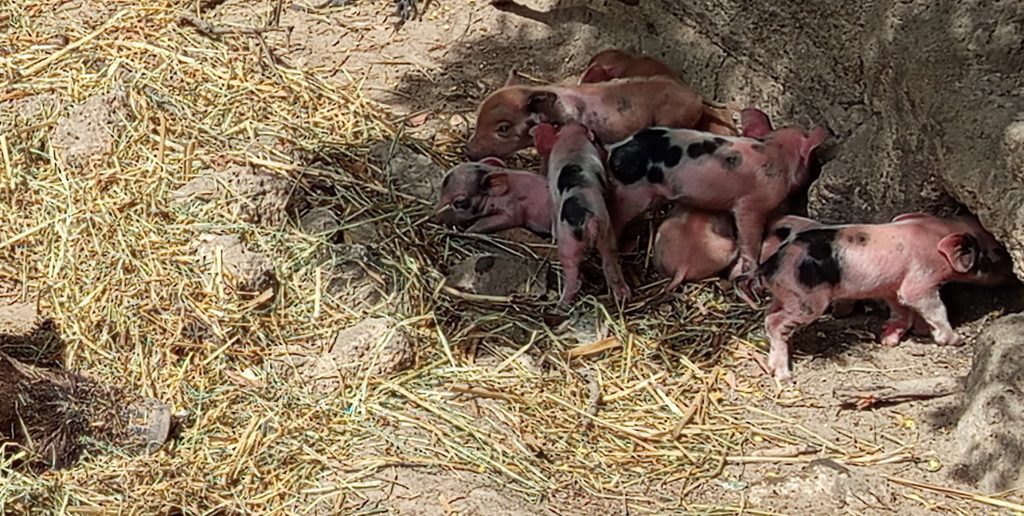
On Sunday 27th September 2025. Zoo record a birth of five(5) new born Piglets, as well on Tuesday 21st October 2025 another 8peight(8) Piglets were born and on Wednesday 23rd October 2025, another Nine(9) piglets were also born all in good health.
Conservation status: Domestication.