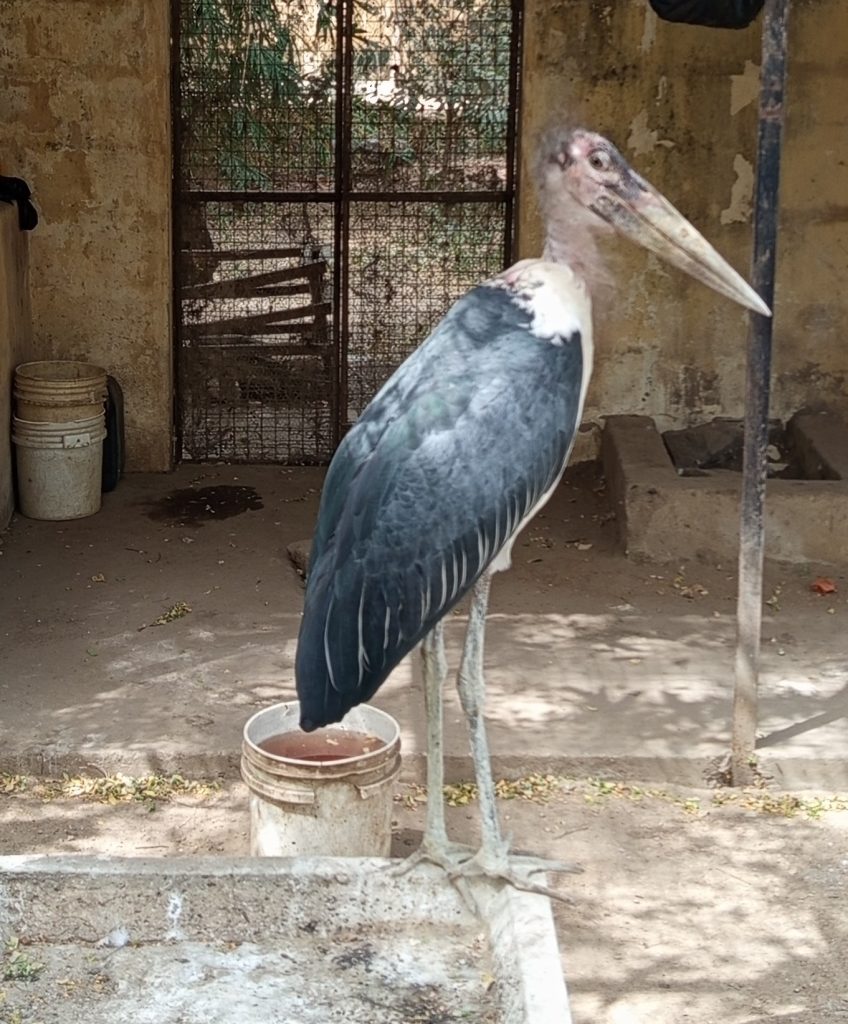
The word marabou stork (Leptoptilos crumenifer) is thought to come from an Arabic word meaning ‘hermit like’ or ‘quiet’. The marabou stork is a huge and fairly imposing bird that makes up part of the stork family, It is native to sub-Saharan Africa and found in a variety of habitats that range from fairly dry to pretty wet and include savannas, grasslands, lakes, rivers, swamps and even rubbish heaps. The marabou stork reach sexual maturity at 4 years old. During breeding season marabou storks generally feed on live prey, such as certain birds and chicks, but also insects, frogs, lizards and eggs. This is linked to the fact that their offspring require live food when born and it is easier to eat the same during this period. They will also eat other carrion or dead animals they find, which serves as an important function to stop the spread of disease.
Marabou storks generally breed during dry seasons, as it is easier to find their live food sources when bodies of water begin to dry up. They nest high in trees, often in large social colonies. They form monogamous pairs, with females laying between 2-3 eggs after 30 days of incubation. It has black feathers that cover its back and wings, with white feathers around its neck and underbody. It has long, skinny legs, which help it wade through water if necessary and a large, pale yellow, wedge-like beak. They have small beady eyes surrounded by red mottled bare skin. Their heads and necks are relatively feather free, with males and females both having large throat sacs, or gular sacs, that hangs below its throat. It inflates this with air and uses it to make particular noises linked to their nostrils, especially during courtship rituals throughout the mating season. Their size range from 120 – 150cm in height, Its wingspan is one of the largest of any land birds on the planet, from tip to tip a marabou’s wingspan can reach between 225–287 cm (7–9 ft). These storks can fly high up in the air searching for food and utilizing thermals. They have been seen as high up as 13,000 feet. They can weight 4.5 – 9kg. they are Scavengers feeding on any animal matter they can find plus carrion, scraps and sometimes animal faeces. On the whole these birds are fairly silent as they don’t have a voice box, but can be seen clacking their bills known as ‘bill-rattling’ when displaying to others. Their predators are mainly Lions and other large cats. Their conservation status is Least concern. A group of marabous is known as a flight, muster or phalanx. Live up to 25 years in the wild, and 40 in captivity.