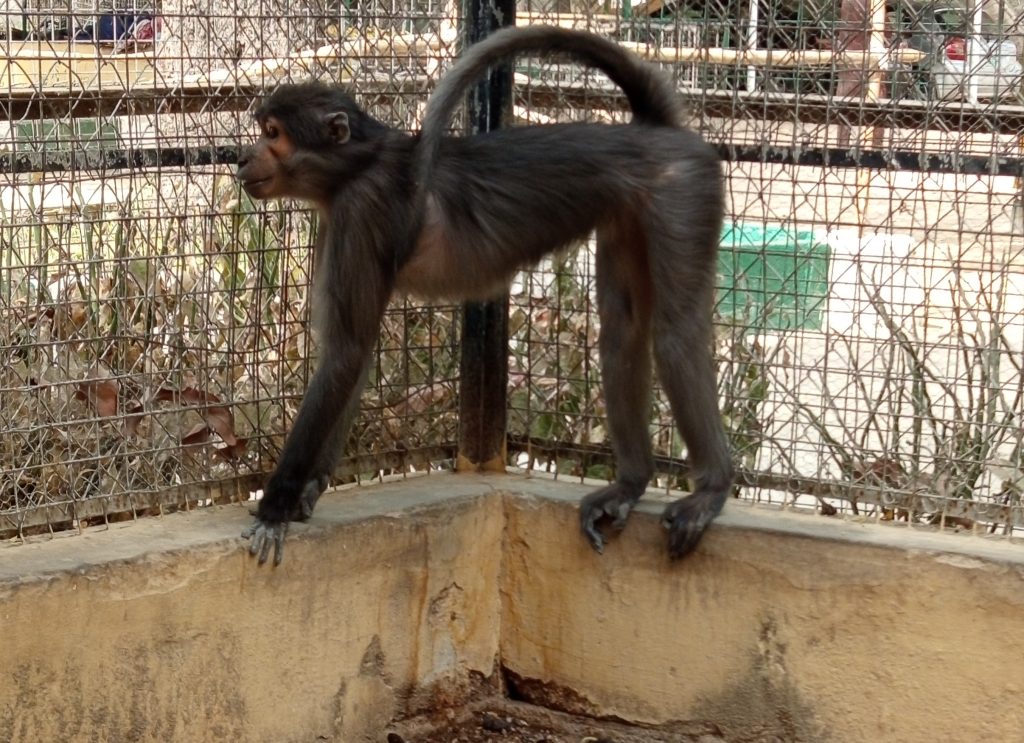
Sooty Mangabey (Cercocebusatys), sometimes called the “white-crowned mangabey” in older literature. Found in West Africa: from Senegal, Guinea, Sierra Leone, Liberia, Ivory Coast, Ghana, and into western Nigeria. Their Primary habitat is lowland tropical rainforest, swamp forest, and gallery forest along rivers. Also uses secondary forest and sometimes agricultural land adjacent to forest patches at sea level up to 1,200 m elevations. They have a dark sooty gray to black coat often with a lighter under side, white crown or eyebrows in some subspecies, and a strong vocal repertoire. Weighing 5-9 kg (males larger).
Sooty mangabeys lives in multi-male, multi-female groups of 10-30 (up to 50)individuals called. Females form stable bonds and rank among females is relatively egalitarian compared to other primates, but higher-ranking females get priority access to food and grooming. Males disperse at maturity, join new groups, and compete for dominance through displays and occasional fights. Alpha male typically has the most mating opportunities, but multiple males can sire offspring. Communication is vocal (loud barks, whistles) and visual (eyelid flashing, tail displays).
They’re diurnal and primarily arboreal, but frequently descends to the ground to forage with a typical home range of 1-3km² varying with fruit availability; larger in lean seasons. Omnivorous in nature, frugivore-insectivore (60-80% of diet is fruit) feeding on varieties such as; figs, dialium, uapaca, and supplemented with seeds, nuts, insects, small reptiles, and occasionally small mammals and birds eggs. They uses their cheek pouches to store food, allowing it to transport large quantities from feeding sites to safer areas or for later consumption. Playing a role in seed dispersal for many forest trees.
Sooty mangabeys have no strict breeding season, but births often peak in early wet season when food is abundant. Having a gestation period of 160-180 days. Typically one infant per birth; twins rare. Inter-birth interval 1-2 years, depending on food availability. Sexual maturity for females is around 3-4 years and males 5-6 years. Mother provides all direct care: nursing for 6-12 months, carrying infant on her belly for the first few weeks, then on her back. Other group members, especially related females, often engage in alloparenting (grooming, protecting the infant). Males generally do not provide direct care but may protect the group and help deter predators.
Their lifespan in the wild ranges between 20-25 years average, maximum 30 years.While in captivity they can live up to 35 years as recorded. Conservation status according to IUCN is Near threatened (2020 assessment). Population trend is decreasing due to habitat loss (logging, agricultural expansion), hunting for bushmeat and pet trade and also diseases (e.g simian immunodeficiency virus as it’s naturally a host).