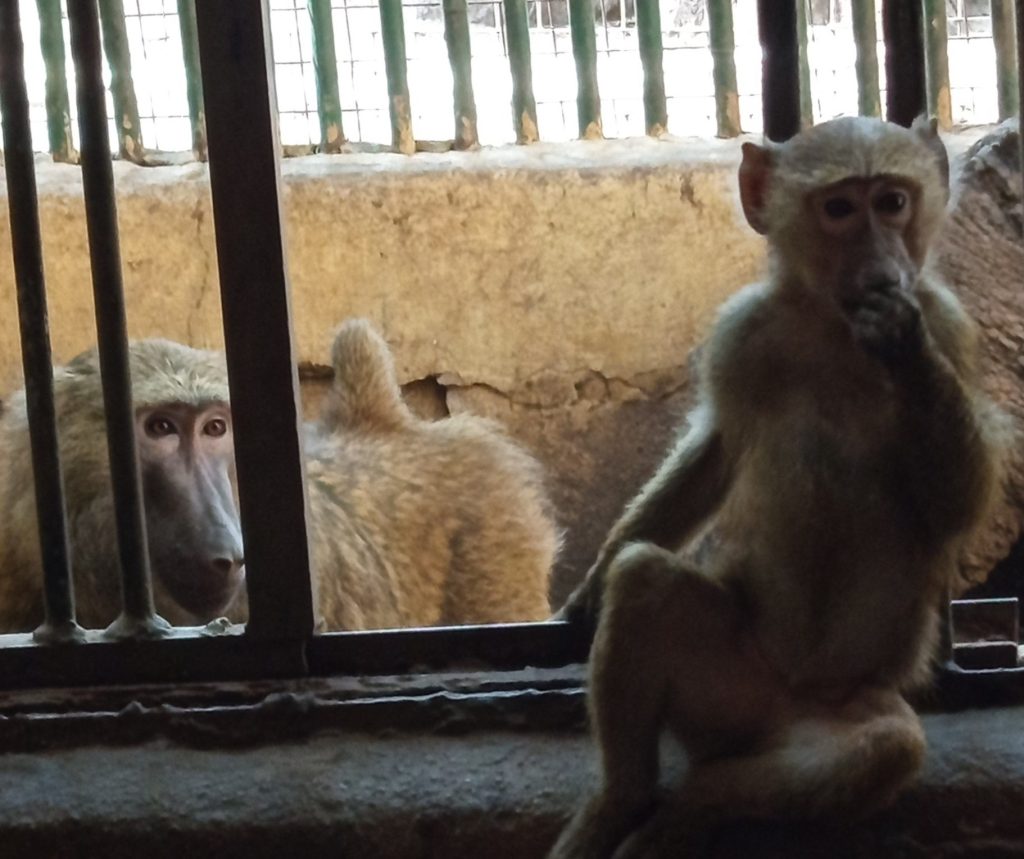
The olive baboon scientifically called Papio anubis and Bika in Hausa language is one of the six species of baboon (Genus Papio) worldwide. An old world monkey, it’s the most wide-range specie of all baboons native to 25 countries throughout Africa, inhibiting some mountainous regions of the Sahara, savannahs, steppes, and forests. The common name is derived from its coat color, which is a shade of green-grey at a distance and are predominantly quadrupedal and terrestrial (at times, bipedal). Their varying mode of communications (vocal and non-vocal), facilitate a complex social structure. They live in multi male – multi female groups (troops) of about 15-150 members, spending most of their time travelling, a diurnal specie active during the day and sleep at night, activity budget consists of mostly travelling and foraging taking more than half of their day. Olive baboons are sexually dimorphic; male size nearly double that of a female, however the weight can fluctuate based on habitat and diet; captive olive baboons are larger than those in the wild. Olive baboons are opportunistic omnivores, feeding on insects, scorpion, spider, plants parts, birds, eggs etc. Their foraging habits allow them to inhabit diverse biomes, they are both scavengers and hunters, and diets are based on seasonality, location and availability.
Olive baboons been social animal utilize facial gestures, and vocalizations to communicate. In the wild Olive baboons use contact calls when foraging to keep track of their group members. Breeding occurs year-round, males and females are known to take multiple mates; Males tend to prefer breeding with seasoned mothers for reproductive success. A high-ranking female may give birth more frequently than low-ranking females. Male and female couples engage in courtship (a temporary relationship) spending time with each other, copulating and groomig during estrus. Gestation lasts for 180-185 days, babies depend solely on their mothers in the beginning cling them safety as they travel and feed later on, they riding on their mother’s backs as their protective maternal instincts are very strong, other females in the group help out to care for the infants. Babies are weaned at 10-12 months, at this stage males may babysit to allow females to forage, participate in grooming, and offer protection while demonstrating group interactions that the youngsters will carry into their adulthoods. This is especially important for other young males to observe before they leave their troop and find their own one day. Olive baboons are good seed dispersers, given their wide territory range they are able to a help in forest regeneration and aerate the soil (when foraging for seed, roots and tubers) as they’re subterranean browsers. Predators of the olive baboon include lions, leopards, serval cats, wild dogs, hyenas, chimpanzees, crocodiles, and domestic dogs, with youngsters specifically susceptible to raptors. Individuals can live for 25-30 years in the wild, in captivity individual can live up to 48 years old. The conservation Status ofolive baboon is least concern according to IUCN.
On Sunday 24th August, 2024, the agency recorded the birth of a healthy olive baboon after decades of recording stillbirth in captivity.